
Magical Christmas Markets of Austria and Germany
Experience the holiday spirit in Austria and Germany, where the tradition of the Christkindlesmarkt began over 600 years ago. Explore Christmas markets alive with festive cheer and cultural treasures. Uncover the history and tastes of these incredible regions spending five relaxing nights in Innsbruck, where the spirit of Christmas is undeniable. Venture to the Alpine village of Seefeld via train and partake in a traditional taste of schnapps before you’re whisked away on an actual horse-drawn Christmas sleigh. Head to Salzburg for an expert-guided walking tour and delight in dinner at the centuries-old St. Peter Stiftskulinarium. Embark on the journey of a lifetime in this winter wonderland, where twinkling lights illuminate entire regions, and the spirit of Christmas is alive and well.
Experience the holiday spirit in Austria and Germany, where the tradition of the Christkindlesmarkt began over 600 years ago. Explore Christmas markets alive with festive cheer and cultural treasures. Uncover the history and tastes of these incredible regions spending five relaxing nights in Innsbruck, where the spirit of Christmas is undeniable. Venture to the Alpine village of Seefeld via train and partake in a traditional taste of schnapps before you’re whisked away on an actual horse-drawn Christmas sleigh. Head to Salzburg for an expert-guided walking tour and delight in dinner at the centuries-old St. Peter Stiftskulinarium. Embark on the journey of a lifetime in this winter wonderland, where twinkling lights illuminate entire regions, and the spirit of Christmas is alive and well.
Highlights
- This is the capital of the state of Tyrol in the Alps of western Austria. Innsbruck is famous as a winter sports center and was the site of the 1964 and 1976 Winter Olympics. It is beautifully situated in the valley of the Inn River, and its most famous sights are the Golden Roof (a structure made from 2,800 gilded copper tiles that was added in 1500 to a building to celebrate the marriage of Emperor Maximilian I), the beautifully preserved city center with buildings covered in traditional Christmas decorations in the season, and the surrounding mountains.
- Perched on a plateau high in the Alps is the charming Tyrolean town of Seefeld. Reminiscent of a fairy-tale Christmas village, this magical place offers a quintessential Austrian wintertime experience in one of the world's greatest ski resorts. The perfect location for snow sports, it has proudly hosted several Olympic and World Ski Championship competitions. It is particularly festive during the holiday season and is an ideal time to take in the crisp mountain air, epic views of villages covered in a white blanket of snow and the spectacular mountain scenery. Enjoy a relaxed atmosphere in this Alpine setting with miles of walking trails, lakes, fine shopping, dining possibilities and pure, fresh air.
- Travel by train to Seefeld, where upon arrival you will be met by drivers and horse-drawn carriages. Choose to add a glass of schnapps to warm you up as you take a scenic carriage ride around the traditional ski-village, with a back drop of the Alps behind.
- The name of this city means “Salt Fortress” and it comes from the custom of taxing salt shipments down the Salzach River. It is the 4th largest city in Austria, and the capital of the state of Salzburg. The baroque Old Town is a UNESCO World Heritage site, and the city sits in a valley surrounded by the Alps. Mozart was born here in the 18th century, and the city was the setting for “The Sound of Music”. Salzburg became part of Austria in the early 19th century, given by Bavaria. Some of the important sights are the Salzburg Castle, Salzburg Cathedral, Mirabell Gardens, the birthplace of Mozart and sites associated with “The Sound of Music.”
- Enjoy the 1,200-year-old St. Peter Stiftskulinarium. St. Peter is a restaurant within the monastery walls of St. Peter's archabbey in Salzburg, Austria. At the heart of Europe’s oldest restaurant, which dates back to 803, is Austrian culture, history, and modernity. St. Peter was first built as an inn, then prospered as a home to nobility, including Austrian composer Michael Haydn. It soon became the quarters for French troops during the Napoleonic wars in 1809. The culinary arts have flourished for centuries at St. Peter and continue to evolve. Seasonal changes and sophisticated ingredients contribute to an ever-changing dining experience.
- Inspired by Versailles and built by King Ludwig II of Bavaria in 1886, Linderhof Palace has a Baroque facade with rich Rococco ornamentation inside. The Palace is an excellent way to see the incomparable artistry of the era’s craftspeople. Look for such lush decorations as a carpet made of ostrich plumes, an ivory candelabra and a table top inlayed with lapis-lazuli, amethyst and chalcedony.
- This German town of 5,100 people is located in the Bavarian Alps, very close to the Austrian border. It is most famous for the Passion Play, which takes place here every 10 years. It was first held in 1634 to give thanks for escaping the Bubonic Plague and is performed only by inhabitants of Oberammergau. Almost half of the villagers took part in the last play in 2010. The town is also known for traditional Alpine woodcarving and frescoes on house facades, so walking through the center is like being in a museum. Many shops sell examples of the woodcraft. During WWII, Messerschmitt aircraft were built here, partly in tunnels in the mountain behind the town. Now the German Army and the NATO School occupy the former Nazi barracks here.
- This is the 3rd largest city in Germany and capital of Bavaria, population about 1.5 million in the city itself. It began as the site of a Benedictine monastery where the old city is today, and the name of the city comes from the word “monk”. It is famous today as the home of Oktoberfest and the Hofbrauhaus, the Glockenspiel clock in the Old Town Hall, its Christmas Market and the headquarters of BMW and Siemens. There are several universities there and it was the site of the 1972 Summer Olympics.
- The Christmas markets in Europe typically open the last week of November and close on Christmas Eve. The tradition began in the Middle Ages in central Europe, what is now Germany, eastern France, and Austria, and now there are markets in many European countries. There is usually a Christmas tree, a nativity scene, and many booths selling traditional regional toys, food, beer, and glühwein or vin chaud (hot mulled wine). Some famous markets are in Nuremberg, Cologne, Frankfurt, Strasbourg (France), and Rothenberg. As many as 3 million people will visit each one every year.
Hotels
- AC Hotel by Marriott — Innsbruck
- Mövenpick Hotel Munich Airport — Munich
Details
- Tour Operator
- Collette
- Start City
- Innsbruck
- End City
- Munich
- Duration (Days)
- 8
- Activity Level
- Level 2
What's Included
- 10 meals included
- This is the capital of the state of Tyrol in the Alps of western Austria. Innsbruck is famous as a winter sports center and was the site of the 1964 and 1976 Winter Olympics. It is beautifully situated in the valley of the Inn River, and its most famous sights are the Golden Roof (a structure made from 2,800 gilded copper tiles that was added in 1500 to a building to celebrate the marriage of Emperor Maximilian I), the beautifully preserved city center with buildings covered in traditional Christmas decorations in the season, and the surrounding mountains.
- Perched on a plateau high in the Alps is the charming Tyrolean town of Seefeld. Reminiscent of a fairy-tale Christmas village, this magical place offers a quintessential Austrian wintertime experience in one of the world's greatest ski resorts. The perfect location for snow sports, it has proudly hosted several Olympic and World Ski Championship competitions. It is particularly festive during the holiday season and is an ideal time to take in the crisp mountain air, epic views of villages covered in a white blanket of snow and the spectacular mountain scenery. Enjoy a relaxed atmosphere in this Alpine setting with miles of walking trails, lakes, fine shopping, dining possibilities and pure, fresh air.
- Travel by train to Seefeld, where upon arrival you will be met by drivers and horse-drawn carriages. Choose to add a glass of schnapps to warm you up as you take a scenic carriage ride around the traditional ski-village, with a back drop of the Alps behind.
- The name of this city means “Salt Fortress” and it comes from the custom of taxing salt shipments down the Salzach River. It is the 4th largest city in Austria, and the capital of the state of Salzburg. The baroque Old Town is a UNESCO World Heritage site, and the city sits in a valley surrounded by the Alps. Mozart was born here in the 18th century, and the city was the setting for “The Sound of Music”. Salzburg became part of Austria in the early 19th century, given by Bavaria. Some of the important sights are the Salzburg Castle, Salzburg Cathedral, Mirabell Gardens, the birthplace of Mozart and sites associated with “The Sound of Music.”
- Enjoy the 1,200-year-old St. Peter Stiftskulinarium. St. Peter is a restaurant within the monastery walls of St. Peter's archabbey in Salzburg, Austria. At the heart of Europe’s oldest restaurant, which dates back to 803, is Austrian culture, history, and modernity. St. Peter was first built as an inn, then prospered as a home to nobility, including Austrian composer Michael Haydn. It soon became the quarters for French troops during the Napoleonic wars in 1809. The culinary arts have flourished for centuries at St. Peter and continue to evolve. Seasonal changes and sophisticated ingredients contribute to an ever-changing dining experience.
- Inspired by Versailles and built by King Ludwig II of Bavaria in 1886, Linderhof Palace has a Baroque facade with rich Rococco ornamentation inside. The Palace is an excellent way to see the incomparable artistry of the era’s craftspeople. Look for such lush decorations as a carpet made of ostrich plumes, an ivory candelabra and a table top inlayed with lapis-lazuli, amethyst and chalcedony.
- This German town of 5,100 people is located in the Bavarian Alps, very close to the Austrian border. It is most famous for the Passion Play, which takes place here every 10 years. It was first held in 1634 to give thanks for escaping the Bubonic Plague and is performed only by inhabitants of Oberammergau. Almost half of the villagers took part in the last play in 2010. The town is also known for traditional Alpine woodcarving and frescoes on house facades, so walking through the center is like being in a museum. Many shops sell examples of the woodcraft. During WWII, Messerschmitt aircraft were built here, partly in tunnels in the mountain behind the town. Now the German Army and the NATO School occupy the former Nazi barracks here.
- This is the 3rd largest city in Germany and capital of Bavaria, population about 1.5 million in the city itself. It began as the site of a Benedictine monastery where the old city is today, and the name of the city comes from the word “monk”. It is famous today as the home of Oktoberfest and the Hofbrauhaus, the Glockenspiel clock in the Old Town Hall, its Christmas Market and the headquarters of BMW and Siemens. There are several universities there and it was the site of the 1972 Summer Olympics.
- The Christmas markets in Europe typically open the last week of November and close on Christmas Eve. The tradition began in the Middle Ages in central Europe, what is now Germany, eastern France, and Austria, and now there are markets in many European countries. There is usually a Christmas tree, a nativity scene, and many booths selling traditional regional toys, food, beer, and glühwein or vin chaud (hot mulled wine). Some famous markets are in Nuremberg, Cologne, Frankfurt, Strasbourg (France), and Rothenberg. As many as 3 million people will visit each one every year.
Pricing
| Option | Price | Departure | Return |
|---|---|---|---|
| Double | USD 3,399.00 | 2027-11-26 | |
| Single | USD 4,299.00 | 2027-11-26 | |
| Triple | USD 3,349.00 | 2027-11-26 | |
| Double | USD 3,399.00 | 2027-12-01 | |
| Single | USD 4,299.00 | 2027-12-01 | |
| Triple | USD 3,349.00 | 2027-12-01 | |
| Double | USD 3,399.00 | 2027-12-06 | |
| Single | USD 4,299.00 | 2027-12-06 | |
| Triple | USD 3,349.00 | 2027-12-06 | |
| Double | USD 3,399.00 | 2027-12-11 | |
| Single | USD 4,299.00 | 2027-12-11 | |
| Triple | USD 3,349.00 | 2027-12-11 | |
| Double | USD 3,399.00 | 2027-12-16 | |
| Single | USD 4,299.00 | 2027-12-16 | |
| Triple | USD 3,349.00 | 2027-12-16 |
Itinerary
-
Day 1: Overnight Flight
You’re on your way to discover the unique charms of Austria and Germany and the magic of Christkindlesmarkt (Christmas market)!
-
Day 2: Innsbruck, Austria
Welcome to Innsbruck, the capital of the Alps. Settle in for a 5-night stay surrounded by breathtaking mountain scenery. As arrival times will vary, there is no scheduled sightseeing today. Spend the day as you wish, exploring the city independently or relaxing and unwinding. This evening, join your fellow travelers for a welcome dinner celebrating the start of your Austrian festive journey.
-
Day 3: Innsbruck - Seefeld - Innsbruck
This morning, it’s your choice! Join a cultural Innsbruck tour featuring a scenic drive past the Bergisel Ski Jump and along Maria-Theresien-Strasse before exploring the charming Old Town. See the Imperial Palace courtyard, St. Jacob’s Cathedral, and the iconic Golden Roof as your guide shares the city’s Habsburg history -OR- ascend to the breathtaking Nordkette.* Ride the funicular and cable car to Seegrube, nearly 6300 feet above sea level, where sweeping views of the Inn Valley and surrounding Alpine peaks await. After lunch on your own, journey by train to the idyllic village of Seefeld at 3600 feet above sea level. Breathe in the crisp Alpine air before climbing aboard a horse-drawn carriage, complete with a warming schnapps. Enjoy an interactive strudel-making (and tasting!) before returning to Innsbruck for an evening at leisure.
-
Day 4: Innsbruck - Salzburg - Innsbruck
Travel through the Austrian countryside to Salzburg’s storybook Old Town. Stroll through the baroque heart of the city, including Mozart’s birthplace and Mirabell Gardens** with the famed “Do-Re-Mi steps” from The Sound of Music. Enjoy a free afternoon exploring Salzburg’s festive Christmas markets. Your afternoon concludes at St. Peter Stiftskulinarium, Europe’s oldest continuously serving restaurant, where you can savor traditional Austrian cuisine in a centuries-old setting.
-
Day 5: Innsbruck
Spend the day at leisure soaking in Innsbruck’s enchanting Christmas markets. Wander among festive stalls filled with seasonal treats, handcrafted gifts, and the sounds of brass bands echoing from the towers. Sip glühwein, sample stollen, and watch for the appearances of St. Nicholas and even Krampus. This evening, you may choose to attend an optional Tyrolean dinner and folklore*** show.
-
Day 6: Innsbruck - Oberammergau, Germany - Innsbruck, Austria
Tour Linderhof Palace, the only palace out of three that King Ludwig II lived to see completed. Walk the extraordinary halls, inspired by Versailles, with an expert guide and learn about Bavaria’s “Fairy-Tale King”. Continue to Oberammergau, a charming Bavarian village known for its painted façades and rich artistic heritage. Enjoy a lunch featuring regional cuisine, followed by time at leisure to explore.
-
Day 7: Innsbruck - Munich, Germany
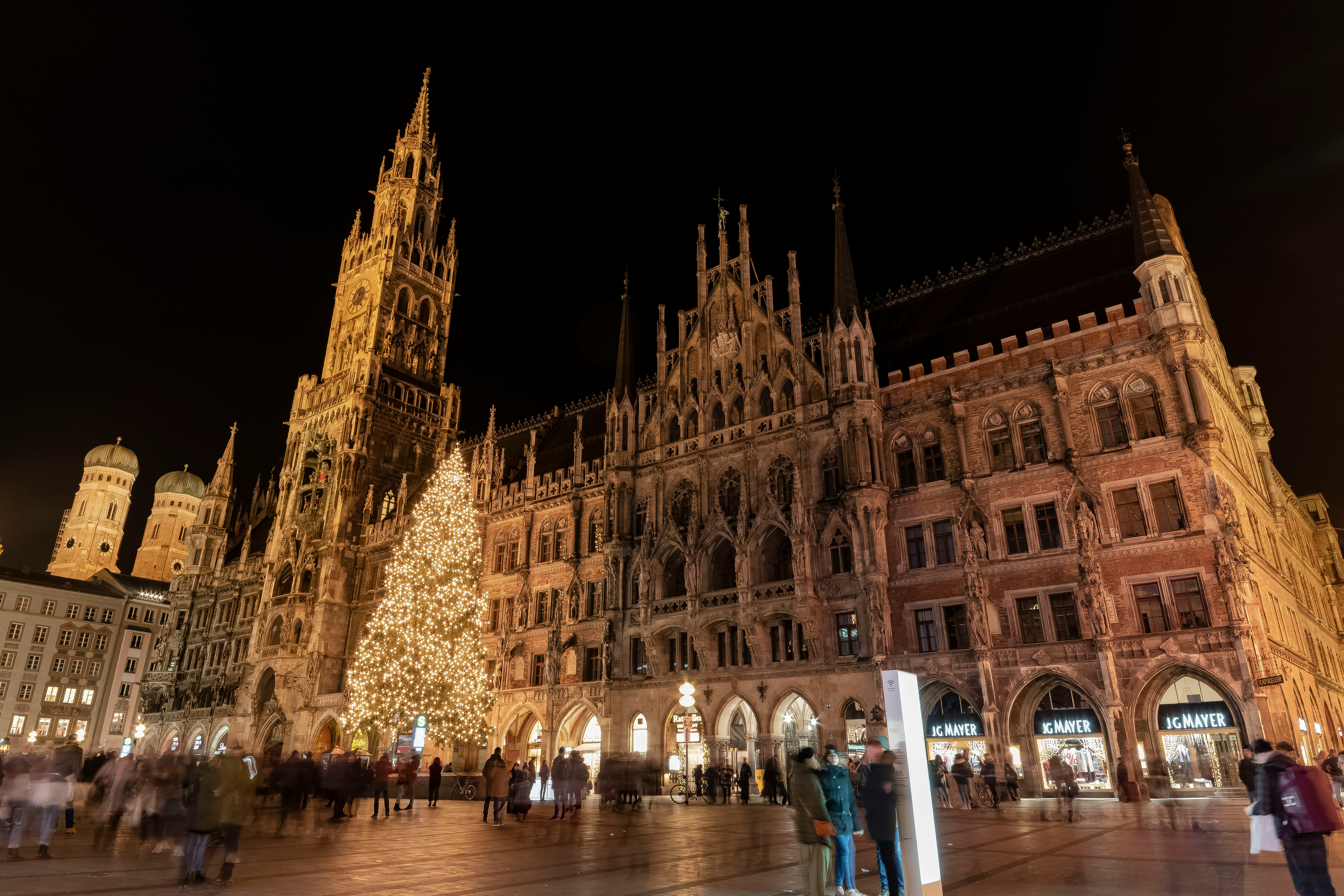
Willkommen to Munich! Visit Marienplatz to witness the famous Glockenspiel,**** where life-size figurines spin and dance. Enjoy free time to explore, perhaps stopping at the renowned Hofbrauhaus or browsing one of Europe’s largest Christmas markets. Join a local guide for a tour of Munich, passing landmarks such as the Royal Square and the Parliament Building. Close your day by celebrating your journey with a farewell dinner before retiring to your hotel near Munich Airport.
-
Day 8: Munich - Tour Ends
Your tour comes to a close today.